Special mention · Side initiative
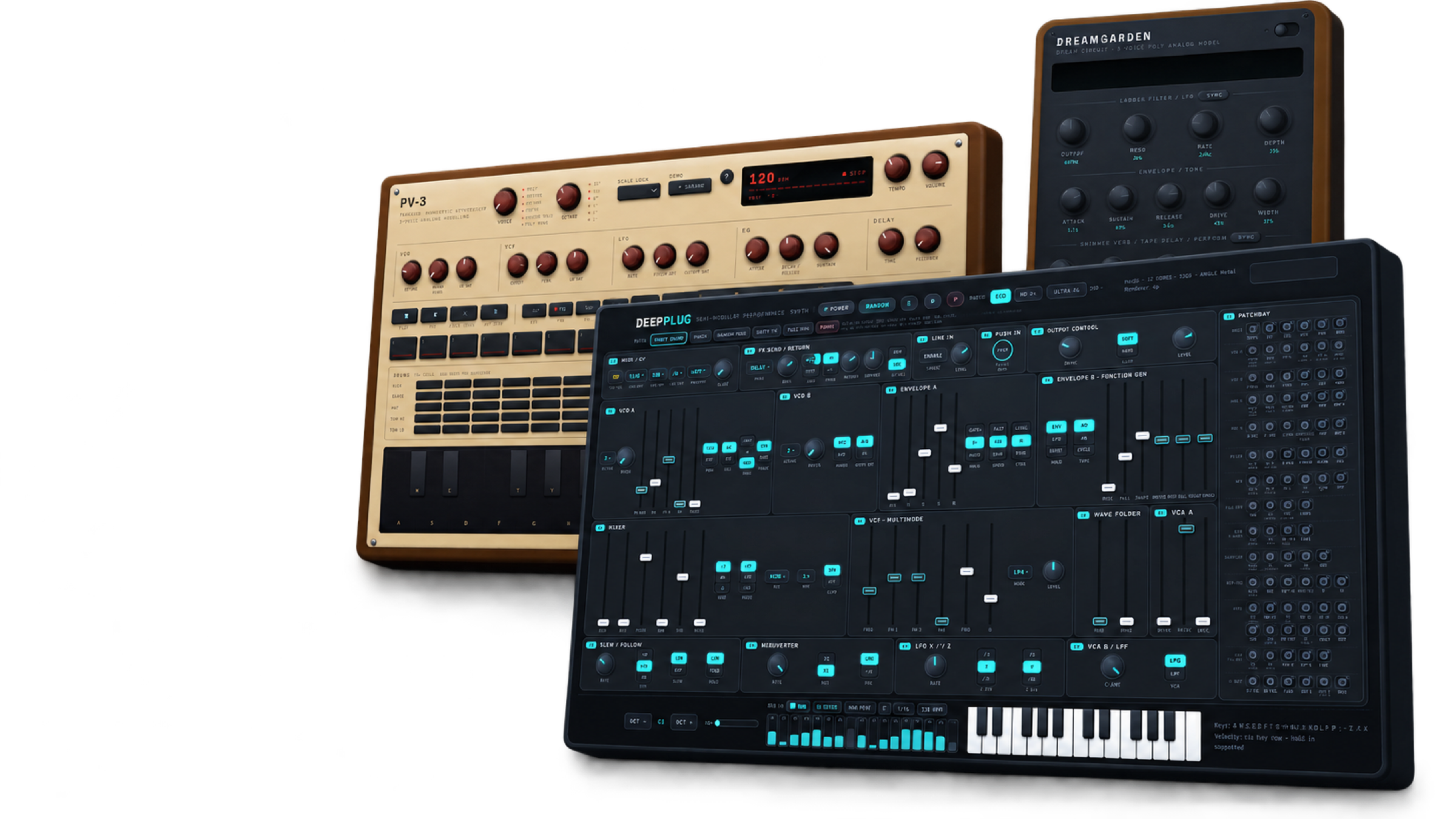
Browser-Native Synth Family
Four instruments exploring how VST-scale sound design can live on the web
Independent initiativeTL;DR
I designed four browser-native synth concepts exploring different ways to make music, from ambient sketches to deep semi-modular experimentation. The family combines clear signal paths, visible control feedback, and computer-keyboard playability, with three instruments available as live browser demos.
Playable in your browser
Play the instruments
No install. No account. Pick a synth and make some noise.
DreamGarden
Ambient synthesizer + sequencer
Model D
Modular subtractive synthesizer
Paravox
Three-voice paraphonic synthesizer
The Short Version
This side initiative explores a simple proposition: expressive software instruments should be playable from a link, without installation, accounts, or a studio setup. I designed four synth concepts as one family, ranging from an approachable ambient instrument to a dense semi-modular workspace. Each concept tests a different balance between immediacy, learnability, performance, and deep control.
The Mess
A hardware panel can rely on physical scale, muscle memory, and dedicated controls. A browser instrument has to recreate that confidence through pixels, while supporting a mouse, trackpad, computer keyboard, MIDI input, smaller screens, and limited attention. The challenge was to preserve the character and directness of a real instrument without turning the interface into either a decorative replica or a generic settings panel.
My Part in This
- Defined four product directions around distinct musical jobs: live pattern-making, subtractive sound design, ambient sketching, and semi-modular experimentation.
- Translated oscillators, filters, envelopes, modulation, effects, sequencing, and patching into visible browser interaction models.
- Designed consistent feedback for control values, active steps, recording, playback, routing, engine state, and keyboard input.
- Created detailed, implementation-minded interfaces that can later be connected to the working HTML instruments as interactive portfolio demos.
Choices Were Made
- Design each synth around a creative outcome instead of forcing one universal level of complexity.
- Keep the signal path legible through grouping, labels, control hierarchy, and persistent state feedback.
- Use the computer keyboard as a first-class instrument so every visitor can play immediately.
- Treat visual character as functional: each instrument should communicate its sound, depth, and intended pace before a note is played.
A Synth in a Tab
The goal was not to reproduce hardware panels literally. I kept the tactile cues that help musicians form a mental model—knobs, keys, signal sections, patch points, and sequencer steps—then added the things a screen can do better: precise value readouts, active-state colour, contextual instructions, direct keyboard mappings, preset states, and clearer recovery. The result is familiar enough to explore quickly, but explicitly designed for interaction in a browser.
01 · Paravox Gets Moody
Paravox is the performance-first instrument: a three-voice paraphonic synth for building chords, riffs, and rhythmic sketches in one place. Voice and octave modes shape the musical range; VCO, VCF, LFO, envelope, and delay controls keep the synthesis path approachable. A 16-step note sequencer and compact drum grid turn the synth into a self-contained idea machine, while labelled computer-key mappings make it playable without external equipment.
02 · Three Oscillators Walk In
This concept exposes the classic subtractive signal path with very little abstraction. Controllers feed an oscillator bank, the oscillators enter a mixer, modifiers shape the filter and loudness contours, and the result reaches a dedicated output section. The horizontal architecture helps a learner understand cause and effect, while modulation, patch points, randomisation, recording, and an on-screen keyboard give an experienced musician enough room to discover less predictable sounds.
03 · Dreamgarden Grows Weird
Dreamgarden deliberately reduces the surface area. It is an eight-voice polyphonic instrument for ambient chords and fast musical sketches, centred on a ladder filter, slow modulation, an envelope, stereo width, shimmer reverb, and tape delay. The compact vertical layout gives every control a clear purpose. An eight-step sequencer provides motion without asking the player to manage a full production environment, making the instrument feel closer to a focused musical object than a workstation.
04 · DeepPlug Goes Deep
DeepPlug is the expert end of the family: a semi-modular performance synth with two oscillators, envelopes and function generation, mixing, multimode filtering, wavefolding, effects routing, MIDI/CV controls, and a full patch bay. The interface stays dense because density is part of the value, but it is organised as numbered modules with visible defaults and routing guidance. Engine-quality controls also acknowledge a browser-specific constraint: the musician should be able to trade processing cost for fidelity rather than experiencing performance limits as unexplained failure.